Traditional security operations centers (SOCs) are under unprecedented strain. The volume of security alerts continues to rise, creating alert fatigue that overwhelms teams, erodes analyst effectiveness, and accelerates burnout. As analysts race through thousands of notifications each day, the real risk is not just missed alerts — it’s missed opportunities to investigate, engage, and disrupt active threats before they escalate.
At the same time, adversaries have become more adaptive, interactive, and deliberate. Modern attacks often require analysts to go beyond passive monitoring — validating intent, interacting with malicious infrastructure, and responding dynamically as threats evolve. This kind of direct engagement cannot be automated away. It demands human judgment, contextual understanding, and the ability to safely operate inside the threat environment.
Artificial intelligence (AI) and machine learning (ML) are transforming how SOCs meet these demands. By reducing noise, surfacing meaningful signals, and accelerating investigative workflows, AI enables analysts to focus on what matters most: making decisions and taking action. Rather than replacing human expertise, AI-powered SOCs amplify it, clearing the path so analysts can investigate deeper and respond faster.
This article explores what an AI-powered SOC is, the characteristics that distinguish it from traditional SOC models, and why combining machine intelligence with human-led engagement is essential to defending against today’s and tomorrow’s threats.
What is an AI-powered SOC?
An AI-powered SOC is a modern security operations center that uses machine intelligence to surface patterns, reduce alert noise, and accelerate investigations — while relying on human analysts to validate findings, engage threats directly, and make critical decisions.
AI-powered SOC benefits don’t stop at facilitating key operational sides of the traditional SOC work. They also help organizations cut costs without sacrificing threat detection capabilities.
An AI-powered SOC uses advanced algorithms and automation to:
- Detect threats faster than ever: AI-powered SOCs accelerate threat detection by surfacing high-confidence signals at machine speed, enabling analysts to rapidly validate, investigate, and engage threats before they escalate.
- Automate routine processes: AI reduces time spent on repetitive analysis so analysts can focus on higher-order work — directly interacting with adversaries, validating infrastructure, and advancing investigations beyond the perimeter.
- Boost incident response: AI-powered SOCs use AI-driven playbooks to handle different types of incident cases and orchestrate known steps, such as a playbook for handling phishing emails, ransomware early-stage attacks, and credential compromise. This speeds up incident response time and contains damage before it spreads to other areas within the IT environment — all while analysts retain control over decisions, pivots, and direct engagement with active threats.
- Apply self-learning capabilities: A major advantage of using AI systems in security operations is their ability to self-learn from real-world incidents and adapt to emerging threats. Machine learning systems evolve through continuous analyst feedback, helping teams tune detections faster as threats evolve.
Challenges of the traditional SOC setup
Different challenges distinguish the work of traditional SOCs compared to those powered by AI. The most prominent ones are alert overload, slow threat detection, resource constraints, a reactive defense posture, and a lack of adaptability.
Alert overload
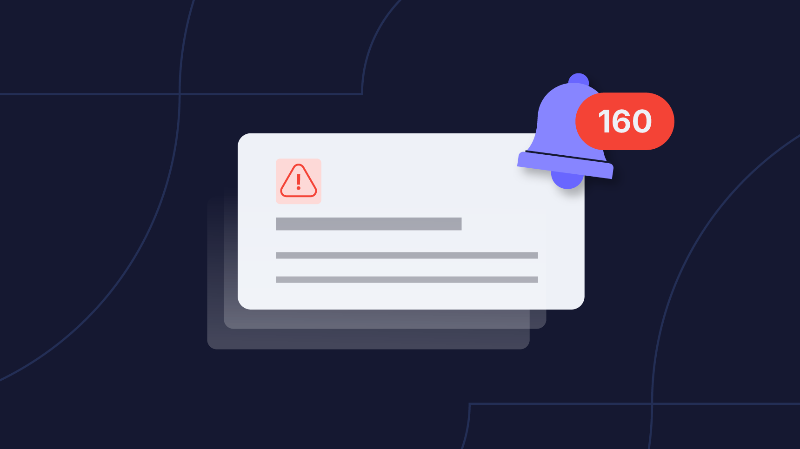
Security teams deal with a large number of alerts every day. According to Cybersierra, the average organization receives 3,832 alerts per day. That’s approximately 160 alerts every hour, or nearly three alerts per minute during standard business hours.
These notifications are generated from various security tools such as SIEMs, EDRs, firewalls, IAM systems, and cloud platforms. The core problem with these alerts is that many of them are false positives, low-value signals, or duplicate notifications from the same event generated by different security tools. Some studies point out that in some environments, false positive rates can exceed 99%. The sheer volume of alerts leads to alert fatigue and makes analysts waste time looking into irrelevant information instead of actual incidents.
Slow threat detection
Traditional SOC depends mainly on fixed rules, predetermined signatures, and predefined correlation logic to identify threats. While this approach proves effective against known threats, which are already catalogued in threat databases, it struggles when confronting novel or evolving attack techniques that deviate from established threat signatures.
As we know, attackers continually use new attack techniques, and using traditional detection methods will create blind spots and prevent the SOC team from detecting evolving threats.
Suppose a threat actor is sending a phishing email that leverages a newly registered domain that has not yet been catalogued in threat intelligence feeds. The malicious email bypasses signature-based filters because:
- The sender domain is clear and has no reputation history (neither good nor bad)
- Email content does not match known phishing templates stored in detection databases
- The embedded URLs within the email point to infrastructure that has not yet been flagged as malicious
- Attachment file hashes are unique to this phishing campaign and have not appeared before
Traditional SOC tools examine this email against their signature databases. When they find no matches, they classify it as legitimate and let it access the network. The phishing email reaches the target’s inbox, the victim clicks the credential harvesting link, and account compromise occurs. All this happened while security systems reported no suspicious activity.
By the time several organizations report the phishing domain and threat intelligence vendors add it to their signature databases, which can usually take 24 to 72 hours after the initial deployment, the attackers have already stolen credentials from hundreds of victims. They could already be working on the next phase of their attack operation.
Resource constraints
Traditional SOCs need large, skilled teams to handle the key functions of SOC operations, such as alert triage, investigations, detection rule tuning, and incident response. This model is costly, requires extensive resources, and is becoming unsustainable due to the global shortage of cybersecurity talent.
For example:
- Tier-1 analysts spend most of their time triaging noisy alerts, a task requiring constant staffing that leads to high burnout and turnover. The repetitive nature of reviewing thousands of alerts daily, where the vast majority are false positives, creates frustration and job dissatisfaction among analysts.
- Tier-2 and Tier-3 analysts must possess deep expertise in digital forensics, threat hunting, cloud security, and incident response. These specialized professionals command premium salaries, and competition for their expertise remains fierce across industries. For instance, around half of all organizations take more than 6 months to fill a cybersecurity vacancy.
- As organizations grow or adopt new cloud services, SOC workloads scale faster than the team can handle, forcing companies to hire more specialists to maintain the same response capability, which requires more resources.
Focus on reactive defense
Traditional SOCs operate mainly in a reactive mode; hence, they wait for alerts to trigger, then begin investigations into the issue. This means threats are only addressed after they have already executed part of the attack chain. This reactive approach slows containment and gives attackers more time to move laterally across the compromised IT environment, escalate privileges, or exfiltrate data.
Here are some practical examples of the shortcomings of the reactive approach:
- Ransomware activity may only generate alerts once the encryption routine begins. This leaves little time for analysts to contain the spread of infection across other endpoints.
- In the event of a credential compromise, it is commonly discovered only after multiple failed logins or unusual access patterns appear in logs. This may allow attackers to establish persistence in the target environment.
- Suspicious outbound traffic may not be flagged until data exfiltration is already underway. This forces SOC teams to work in damage-control mode rather than prevention.
- Cloud account abuse might only trigger alerts once a high-risk API call is executed; this commonly happens long after the attacker has gained access.
Lack of adaptability
Traditional SOCs struggle to keep pace with rapidly evolving threats. The detection logic in these setups depends on manually written rules, signatures, and playbooks that analysts must continuously update to stay current. This leads to slow response times and leaves long periods during which new attack methods remain unnoticed.
For example, adversaries frequently change their tactics, techniques, and procedures (TTPs), such as modifying command-and-control communication patterns to avoid detection rules targeting specific network behaviors or using rotating domains, which requires analysts to rewrite or tune correlation rules constantly. This is a daunting process and consumes a lot of time as each TTP modification forces security engineers to update detection logic as follows:
- Analysts need to track emerging attack techniques through industry reports, threat feeds, and information-sharing communities
- Now, they need to translate threat intelligence into detection logic compatible with SIEM platforms
- New rules should be tested to balance detection efficacy against false positive rates
- Finally, the rules are deployed to production environments and need to undergo continuous adjustment based on operational feedback
Characteristics of an AI-powered SOC
Different characteristics distinguish an AI-powered SOC from traditional SOC centers:
- Autonomous threat hunting: AI-powered SOCs support proactive threat hunting by continuously surfacing suspicious activity — giving analysts a head start in pursuing and engaging emerging threats.
- Behavioral analytics and anomaly detection: ML algorithms establish behavioral baselines for every user, application, system, and network segment within the IT environment. The AI continuously monitors for deviations from normal behavior patterns, which enable it to identify threats even when they employ previously unseen techniques.
- Predictive threat intelligence: ML models examine the features of known threats to predict how future attack methods and infrastructure may look. ML can highlight likely attacker behaviors and infrastructure patterns, helping analysts prioritize what to investigate next.
- Continuous learning and model improvement: ML models automatically improve detection accuracy through continuous feedback loops. For instance, every analyst investigation, false-positive dismissal, and confirmed threat teaches the AI to distinguish malicious activity from benign operations better. For example, suppose an analyst repeatedly marks a specific backup process as benign after it triggers “mass file modification” alerts. In that case, the system learns that this behavior is normal for that host or workload. Conversely, when analysts confirm a series of lateral-movement attempts linked to suspicious PowerShell usage, the model adjusts its baseline and becomes more sensitive to similar sequences; hence, it flags them earlier and with higher confidence.
Why human engagement is still critical
AI can surface signals, patterns, and probabilities at machine speed — but it cannot replace human judgment inside the threat environment. Adversaries adapt, deceive, and respond dynamically to pressure. Understanding intent, validating context, and uncovering second- and third-order risk often requires analysts to directly interact with malicious infrastructure, personas, and content in real time.
Human-led engagement enables analysts to ask better questions, pivot investigations based on nuance, and collect primary-source evidence that automated systems cannot safely or credibly obtain on their own. Whether you need to validate an alert, attribute an actor, or disrupt malicious activity, direct interaction is what turns detection into decision and intelligence into action.
This is where secure, anonymous access becomes essential — empowering analysts to step beyond the perimeter, engage threats at the source, and do so without exposing their identity, infrastructure, or organization.
=======
Traditional SOCs can no longer keep up with modern cyber threats. Alert overload, manual investigations, slow threat detection, and reactive defense models create security gaps that attackers exploit every day.
AI-powered SOCs are no longer optional — but automation alone is not the answer. Machine intelligence accelerates detection and prioritization, but security outcomes still depend on human-led engagement inside the threat environment.
The future SOC is not autonomous. It is augmented — where AI clears the path, and analysts step forward to engage, investigate, and act with confidence.
AI-powered SOC FAQs
Does an AI-powered SOC replace human analysts?
No, AI-powered SOCs don’t replace human analysts. Instead, they augment analysts by filtering noise and highlighting risk — but human judgment remains essential for investigation, attribution, and direct engagement with adversaries.
What role do humans play in an AI-powered SOC?
Analysts interpret context, validate intent, interact with threat infrastructure, and adapt investigations in real time — capabilities AI alone cannot replicate.
Why is direct engagement still necessary in modern SOCs?
Threat actors adapt dynamically. Direct engagement allows analysts to validate behavior, collect primary evidence, and disrupt activity at the source without exposing their organization.
How does AI reduce SOC alert fatigue?
AI prioritizes alerts based on behavior and risk, reducing false positives so analysts can focus on meaningful investigations instead of noise.